Develogic acoustic recorders deployed in Japan’s EEZ to support deep-sea mining environmental assessment
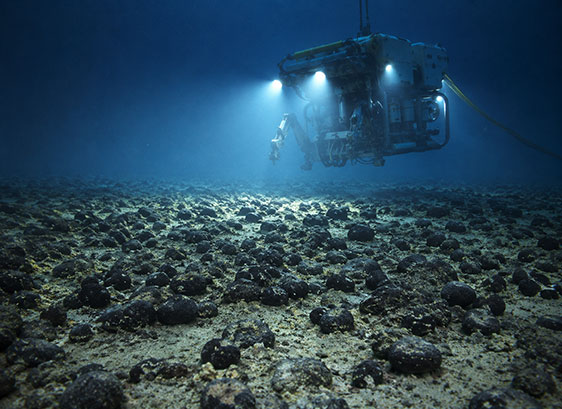
Develogic’s Sono.Vault SubMAReS acoustic recorders have been deployed as part of an environmental impact assessment (EIA) in Japan’s Exclusive Economic Zone, supporting scientific evaluation of the ecological effects of polymetallic nodule extraction at extreme depths – months before Japan’s most significant deep-sea mineral discovery became public.
The assessment is led by the University of Tokyo and Deep Reach Technology, Inc., targeting nodule fields in the seabed around Minamitorishima Island at depths between 5,200 and 5,700 metres. Develogic’s systems were in the water as part of the baseline science phase: the environmental groundwork laid before extraction activities can be sanctioned. That work proved prescient.
In June 2024, the University of Tokyo and the Nippon Foundation jointly announced the discovery of a nodule deposit covering approximately 10,000 square kilometres of seabed, estimated to contain around 230 million tonnes of polymetallic material – including cobalt reserves equivalent to 75 years of Japan’s national consumption. The scale of the find has since accelerated Japan’s timeline toward commercial extraction, with harvester trials anticipated in 2025 and production potentially beginning as early as 2026.
The EIA follows an ecosystem-based management approach in alignment with International Seabed Authority guidelines, with a mandate to establish rigorous environmental baselines before any extraction activities proceed. Develogic’s Sono.Vault SubMAReS systems capture continuous underwater soundscapes and detect marine mammals across the project area. Passive acoustic monitoring of this kind is a foundational requirement in modern deep-sea EIA methodology: sound propagates effectively through water at depth where light does not, making acoustic data one of the most reliable proxies for biological activity and ecosystem health. The datasets generated inform assessments of noise impact, species presence, and habitat disturbance across the full operational lifecycle of the programme.
For Develogic, the project demonstrates the versatility of the Sono.Vault platform. Originally developed for long-duration, autonomous deep-sea acoustic recording, the SubMAReS variant is purpose-built for marine mammal monitoring, with optimised frequency response, on-board detection algorithms, and deployment endurance suited to remote, high-pressure environments. At depths exceeding 5,000 metres, the engineering tolerances involved are considerable: pressure housings, connectors, and electronics must perform reliably over extended periods without maintenance access or intervention.
The Japan EEZ programme positions Develogic as a credible partner for the environmental science dimension of deep-sea resource projects — not as a retrospective supplier, but as part of the scientific infrastructure from the outset. As regulatory frameworks for deep-sea mining mature globally, that early-stage involvement becomes increasingly significant. The data Develogic’s systems collect does not simply satisfy a compliance requirement: it forms part of the scientific record on which extraction decisions, and the public accountability that surrounds them, will ultimately depend.Develogic’s Sono.Vault SubMAReS acoustic recorders have been deployed as part of an environmental impact assessment (EIA) in Japan’s Exclusive Economic Zone, supporting scientific evaluation of the ecological effects of polymetallic nodule extraction at extreme depths — months before Japan’s most significant deep-sea mineral discovery became public.
The assessment is led by the University of Tokyo and Deep Reach Technology, Inc., targeting nodule fields in the seabed around Minamitorishima Island at depths between 5,200 and 5,700 metres. Develogic’s systems were in the water as part of the baseline science phase: the environmental groundwork laid before extraction activities can be sanctioned. That work proved prescient. In June 2024, the University of Tokyo and the Nippon Foundation jointly announced the discovery of a nodule deposit covering approximately 10,000 square kilometres of seabed, estimated to contain around 230 million tonnes of polymetallic material — including cobalt reserves equivalent to 75 years of Japan’s national consumption. The scale of the find has since accelerated Japan’s timeline toward commercial extraction, with harvester trials anticipated in 2025 and production potentially beginning as early as 2026.
The EIA follows an ecosystem-based management approach in alignment with International Seabed Authority guidelines, with a mandate to establish rigorous environmental baselines before any extraction activities proceed. Develogic’s Sono.Vault SubMAReS systems capture continuous underwater soundscapes and detect marine mammals across the project area. Passive acoustic monitoring of this kind is a foundational requirement in modern deep-sea EIA methodology: sound propagates effectively through water at depth where light does not, making acoustic data one of the most reliable proxies for biological activity and ecosystem health. The datasets generated inform assessments of noise impact, species presence, and habitat disturbance across the full operational lifecycle of the programme.
For Develogic, the project demonstrates the versatility of the Sono.Vault platform. Originally developed for long-duration, autonomous deep-sea acoustic recording, the SubMAReS variant is purpose-built for marine mammal monitoring, with optimised frequency response, on-board detection algorithms, and deployment endurance suited to remote, high-pressure environments. At depths exceeding 5,000 metres, the engineering tolerances involved are considerable: pressure housings, connectors, and electronics must perform reliably over extended periods without maintenance access or intervention.
The Japan EEZ programme positions Develogic as a credible partner for the environmental science dimension of deep-sea resource projects — not as a retrospective supplier, but as part of the scientific infrastructure from the outset. As regulatory frameworks for deep-sea mining mature globally, that early-stage involvement becomes increasingly significant. The data Develogic’s systems collect does not simply satisfy a compliance requirement: it forms part of the scientific record on which extraction decisions, and the public accountability that surrounds them, will ultimately depend.
Share:
Related articles
Gabler Group strengthens position in subsea communication and data with contract award from a European navy
Develogic sets new operational depth benchmark and expands offshore wind monitoring portfolio